Prepared Plastics
View Full Project Document (PDF)
Project Summary
Prepared Plastics is a participatory sculptural system that adapts the logic of prepared systems, in which a fixed structural framework is altered through material intervention while remaining functionally intact. Through blind selection, distributed components, and participant assembly, it produces variable sculptural outcomes from shared material fields.
Project Description
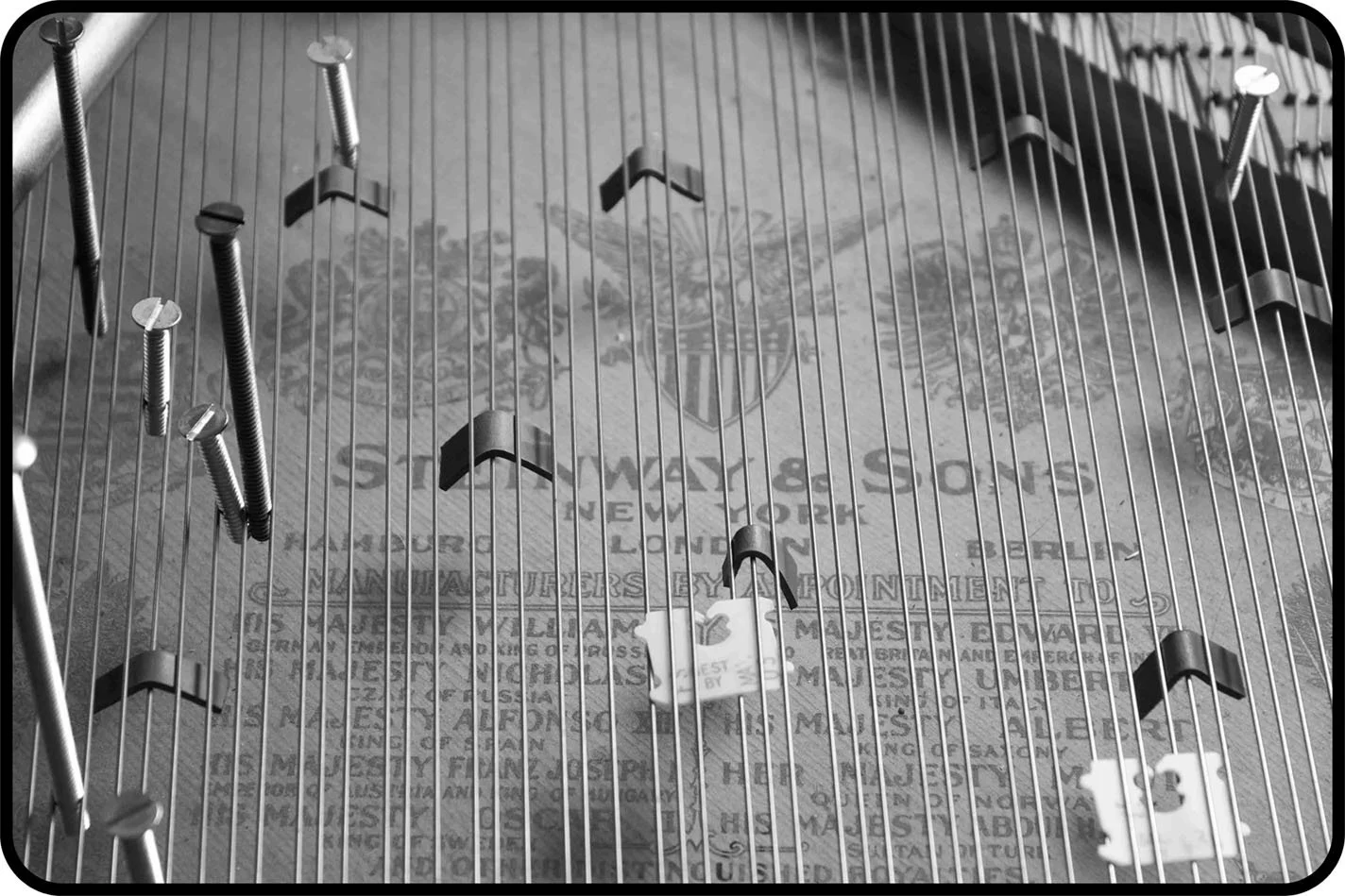
Prepared Plastics adapts the logic of John Cage’s prepared piano: a fixed, rule-based structure is altered through the introduction of a second material system, shifting its behavior while remaining functionally intact.
The project extends this approach into a modular plastic building system, in which participants assemble small, self-contained objects from components that have been pre-prepared through larger material field processes.
The process begins with the generation of continuous surface conditions—“fields”—applied across batches of compatible plastic building elements. Surface treatments such as marbling and color fields transform otherwise uniform elements into materially distinct yet fully functional parts. These fields are then decomposed into discrete components and distributed through a structured system of sealed, fully opaque envelopes organized by component type.
Participants receive a model through blind selection, then gather components through a second stage of blind selection from structured groups of sealed envelopes, assembling their work using intentionally open-ended instructions. While the underlying structure of each object is fixed, variation emerges through three mechanisms: blind model selection, the distribution of prepared components, and interpretive decisions made during assembly.
The resulting sculptures operate across multiple states. Individually, they are resolved objects produced through constraint and choice. Collectively, they form a temporary public grid in which the full system becomes visible: a field of related but distinct outcomes shaped by shared constraints and distributed participation.
The work also translates key principles of long-form generative art into a physical and communal context. Blind selection, distributed components, and participant assembly operate as analogues to seed, script, and execution, shifting variation from code to material and collective action.

Concept
Prepared Plastics adapts the logic of John Cage’s prepared piano, in which a fixed, rule-based system is altered through the introduction of external materials, shifting its behavior while remaining functionally intact.
In Cage’s case, objects placed between piano strings transformed the instrument’s sound without altering its underlying structure—a rule-based system that maps key presses to sound. However, as the work was performed across different instruments and performers, he recognized that control over outcomes could not be fully retained:
“Instead of the possibility of repetition, we are faced in life with the unique qualities and characteristics of each occasion.”
“…the enjoyment of things as they come, as they happen, rather than as they are possessed or kept or forced to be.”
(John Cage, “How the Piano Came to Be Prepared,” 1972)
Prepared Plastics extends this realization into a distributed system in which agency is structured across material preparation, stochastic selection, and participant assembly. Each instance emerges from a specific convergence of structure, material, and action, where variation is an inherent property of the system.
This work operates through the interaction of multiple systems—structural, material, and participatory—whose overlap produces behavior that cannot be fully specified in advance.
System Diagram
This diagram describes the full lifecycle of the system, from material preparation through distribution and assembly to collective display.
Fields
Prepared Plastics begins with the generation of continuous material fields applied across batches of compatible components.
Field generation → surface application → decomposition → distributed components
These fields are produced through surface-based processes that treat many components simultaneously, creating a unified condition across discrete parts. Techniques may include marbling, spraying, direct application, carving, or controlled material transformation. Initial studies have focused on marbling, with additional processes extending the range of possible field conditions.
While the underlying components remain structurally identical, the field introduces variation at the level of surface and material.
Once established, the field is decomposed. Individual elements are separated from the larger surface, carrying fragments of the original condition. Each piece retains a partial trace of the field, but no single component contains it in full.
Through this process, components shift from interchangeable units to materially distinct elements. They remain fully functional within the system, but now operate as distributed carriers of a larger, continuous transformation.
Sculptures
The sculptural forms are defined within a fixed volumetric constraint: each object is designed to occupy and resolve within a standardized transparent enclosure. This enclosure establishes a consistent boundary condition across all works, functioning as both container and frame.
Within this constraint, each model defines a distinct structural framework—an internal logic of connections, surfaces, and adjacencies that guides assembly without prescribing a singular outcome. The forms are intentionally varied in their geometric language, ranging from more planar and modular compositions to those incorporating curvature and nested relationships. This variation allows the system to support different modes of material expression while remaining structurally coherent.
The enclosure plays an active role in how the work is perceived. Its frontal clarity and frosted lateral surfaces create a preferential viewing orientation, emphasizing a primary face while softening peripheral views. This produces a viewing condition analogous to framed or screen-based works: the object is both spatial and image-like, resolved through a specific mode of presentation.
Figure — Field to component to variation
A continuous surface field is applied across components, decomposed, and redistributed. Reassembly within a fixed structural model produces multiple distinct outcomes, demonstrating variation through material distribution and participant assembly.
Material variation introduced through prepared components interacts with these structural frameworks in different ways. In more planar compositions, fields can reassemble into legible patterns across surfaces. In more complex or curved forms, fragments of fields are dispersed, producing localized relationships rather than continuous reconstruction. Together, these approaches demonstrate a range of outcomes within the same system, from coherence to fragmentation.
Activation
Prepared Plastics is realized as a live, table-based activation in which the system is executed through participant interaction.
Collectors enter the work by purchasing a sculpture kit and selecting a base model through blind draw, receiving a sealed instruction booklet that defines the structural framework of their object. They then gather components through a second stage of blind selection from structured groups of sealed envelopes containing both standard and prepared elements.
Assembly takes place on-site within a shared environment, where multiple participants build in parallel. This shared environment supports direct engagement with the system as it unfolds, while also enabling observation, comparison, and exchange between participants. The process is lightly facilitated, allowing for both rapid construction and more extended interaction.
Figure — Collective grid formation over time
Completed works accumulate into a temporary public grid, revealing system-level variation across shared structures and distributed materials.
As works are completed, they are placed into a growing grid display, forming a temporary collective installation. At scale, this grid reveals the system as a field of related but distinct outcomes emerging from shared constraints, stochastic distribution, and participant agency.
Keychains
Prepared Plastics extends into a smaller-format series of keychains, functioning as a distributed entry point into the system.
Each keychain is constructed from prepared components derived from the same material field processes as the larger sculptures. While reduced in scale, they retain the core relationship between structure, surface variation, and assembly.
These works operate as both independent objects and fragments of the larger system: portable instances that carry the logic of the project into a more accessible form.
Intended for inclusion in a community swag bag, they broaden participation by circulating the system beyond the primary activation, allowing engagement through ownership even without direct involvement in the build process.
Generative Structure
The project mirrors the core structure of long-form generative art in a physical context:
Hash / Seed → Blind selection (instructions and envelopes)
Script → Printed instruction set defining structure and behavior
Execution → Assembly through participant interaction
Parameters → Variation through material distribution and build decisions
Token / Output → A unique, constructed sculptural object
Display → A bounded viewing frame (transparent enclosure and frontal orientation)
The system defines a space of possible outcomes resolved through material preparation, distribution, and participant action.